SEO for tour operators means making your tours easy to find when travellers search for a trip, so they book with you directly instead of paying a marketplace a large share of every sale. If your tours are hard to find, you pay twice for each booking: once in commission and once in ad spend. This guide gives you seven practical steps you can start this week.
Why search brings better bookings
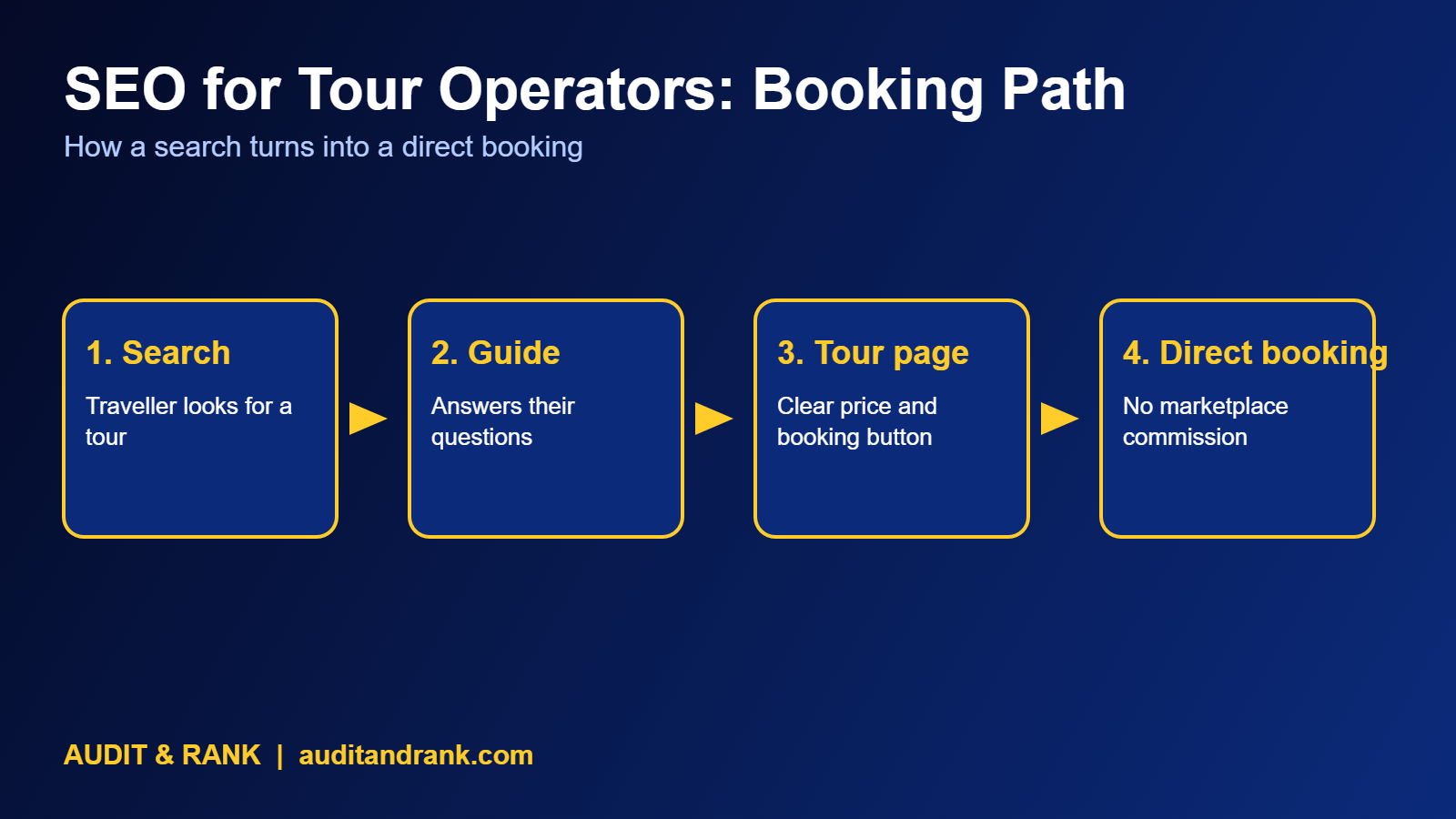
Travellers search before they book. Someone looking for a three-day desert safari or a family trek in the mountains is ready to spend money. When your page ranks for that search, you get the enquiry without paying for each click. Ads stop the moment the budget stops, but a good page keeps bringing enquiries for months.
Strong search visibility also builds trust. Clear prices, honest itineraries and recent reviews answer the questions a buyer has before they call you. That is the real job of SEO for tour operators: help the right traveller feel sure enough to pay.
Step 1: Choose keywords that match buying intent
Start with the words your customers type when they search for SEO for tour operators. Use a keyword tool to collect phrases in three groups: informational searches such as best time to visit, commercial searches such as best tour company in a city, and transactional searches such as book a day tour. Build each main page around one clear phrase, and use the tour name and destination in it. For the basics, read Google’s SEO starter guide.
Look at what the search results already show for SEO for tour operators. If the top results are blogs, a guide will fit. If they are booking platforms, your tour page needs stronger prices, photos and reviews to compete.
Step 2: Give every tour its own page
Each tour needs a dedicated page with a clear title, dates, price range, what is included, a map, real photos and a booking button. Five tours on one page compete with each other and rank badly. A focused page ranks better and converts better, which is why SEO for tour operators starts with good tour pages, not with a long blog.
For example, a small trekking company in the mountains had one page listing eight treks. Visitors could not tell which trek was right for them, and rankings stayed flat for a year. After the company split the page into eight tour pages, each with its own photos and price, enquiries for the longest trek rose within a few months.
Step 3: Write guides that answer real questions
Guides bring traffic from people who are still deciding. Posts such as what to pack for a mountain trek or is a safari worth the cost attract readers early in their search. A guide like this one on SEO for tour operators is a good example, because it answers the questions owners ask before they hire anyone. Link each guide to the tour page that answers the next question. Many tour businesses lose visitors here, because the blog and the booking pages do not talk to each other.
Step 4: Optimise titles, descriptions and images
Put the main phrase near the start of each title, use one H1 heading, and write a meta description that promises a clear benefit. Name your images with descriptive words and add alt text that describes what the picture shows. Search engines read these signals, and travellers use the same details to choose which result to click. A plain title that says what the tour is will beat a clever one that does not. Google explains how titles appear in results in its title link guidance, and how to describe images in its image SEO guide. You can also check your page basics with our free SEO tools.
Step 5: Make the site fast and easy on mobile
Most travel searches happen on phones, so any SEO for tour operators plan must start with a fast mobile site. Compress your images, use a clean theme and test the page speed. A slow site loses the buyer before the itinerary loads, and no amount of good content fixes that. Google also documents page speed and mobile basics in its SEO starter guide.
Step 6: Earn reviews and local mentions
Ask recent guests to leave a review on Google and TripAdvisor. Reviews help local visibility and add trust for every tour, which strengthens SEO for tour operators in search. Partner with hotels, local guides and travel bloggers who can link to your pages. A few relevant links from trusted sites do more for your rankings than dozens of directory listings.
Step 7: Track bookings, not only rankings
Connect Google Search Console to your site and to your booking system. Check which pages bring enquiries and which bring bookings. A page that ranks well but does not convert needs a stronger offer, clearer prices or a better button. Improve those pages first, because they already have the attention you need. For a full check of your rankings and pages, see our SEO audit service.
Local search and destination pages
If you run tours from one city or region, local search matters a lot. Create a page for each main destination you serve, and explain which tours leave from there, how long they take and who they suit. Your Google Business Profile should match your website name, address and phone number exactly. Strong destination pages make SEO for tour operators easier, because a visitor searching for a place will also find your tours. Keep your listing up to date using Google Business Profile help.
Use details that only a local operator knows: meeting points, pickup times, the best season, and the mistakes travellers often make. These details make your page more useful than a generic travel article, and competitors find them hard to copy.
Measuring what works
Track four numbers each month when you run SEO for tour operators work: organic visits to tour pages, enquiries, bookings and revenue from search. Compare them with the month before and with the same month last year, because travel demand changes with the seasons. A rise in visits without a rise in bookings means the page needs a better offer. A rise in bookings without a rise in visits means your offer is strong, so you should send more traffic to it.
Set a simple goal, such as two new enquiries per week from search within six months. A clear target keeps the work focused on the pages that change revenue, instead of a long list of small tasks that do not. Track your data in Google Search Console, and read our website traffic loss audit guide if visits fall suddenly.
Building a plan you can keep
Most tour businesses drop SEO for tour operators after the first month because the work feels slow. Plan one tour page and one guide each month, plus a review request after every trip. Over a year, that rhythm builds a library of pages that keep bringing bookings. SEO for tour operators rewards consistency more than one big project that is never updated.
Share the plan with the people who answer enquiries. When your team knows which pages are being improved, they can send buyers to the right place and report the questions they hear most often. Those questions are often the best topics for your next guide, and they tell you exactly what buyers need to read before they pay. If you want this handled for your business, see our SEO services.
Common mistakes tour operators make
- Copying itineraries from other operators. Duplicate content makes your pages harder to rank.
- Repeating the same phrase too often. Write for the reader first and use the phrase naturally.
- Hiding prices. Show a starting price so buyers know you are a fit.
- Sending visitors to the homepage instead of the tour page they searched for.
Frequently asked questions
How long does it take to see results?
Most tour operators see movement in three to six months, depending on competition and the state of the site. Quick gains often come from fixing titles, internal links and broken pages.
Do I need a blog?
A blog helps, but tour pages come first when you plan SEO for tour operators. Start with your top five tours, then add guides that answer the questions buyers ask before they book.
Is search better than paid ads?
They work together. Ads bring fast traffic, while search brings lower-cost bookings over time. Most operators need both, with search taking a larger share as the site matures.
Which tour page should I optimise first?
Start with the tour that earns you the most profit per booking, not the one with the most visitors. Improve its page, add reviews to it, and link to it from your guides. This is the fastest route to better SEO for tour operators results. To estimate what each new enquiry is worth, try our cost per lead calculator.
Do I need a Google Business Profile?
Yes, if you have a physical meeting point or a local office. A complete profile with photos, opening hours and recent reviews helps you appear in local results, and it works alongside your website rather than replacing it.
Conclusion
SEO for tour operators is a steady process, but it pays back in direct bookings and fewer commission fees. Start with one tour page, one guide and one clear booking button. Then repeat the process for your next tour, and check the numbers every month. More practical guides are on our blog.