Lead generation for contractors comes down to one question: which source brings you customers who actually book? Every contractor wants more leads, but not every lead is worth the same. A lead sent to five companies at once is very different from a homeowner who found only you on Google Maps. This guide to lead generation for contractors compares the main sources in 2026 (shared lead marketplaces, exclusive lead services, Local Services Ads, Google Ads, local SEO and referrals) so you can decide where your money and time should go. Each section starts with a short answer.
Key points
- Shared leads are fast but often sold to several contractors, so speed decides who wins the job.
- Exclusive leads and Local Services Ads cost more per lead, but you are not racing competitors for the same customer.
- Local SEO takes months to build, then brings calls without a fee for each lead.
- The best lead generation for contractors is measured by cost per booked job, not cost per lead.
- Most jobs are lost after the lead arrives: missed calls, slow replies and no follow-up.
What is lead generation for contractors?
Short answer: lead generation for contractors is any system that brings you homeowners or businesses who need your service and are ready to ask for a quote.
For plumbers, roofers, HVAC companies, remodelers and general contractors, a lead is a phone call, a form, a message or a quote request. Good lead generation for contractors is not about the number of leads. It is about how many of them become booked jobs, and what each booked job costs you.
What are the main types of lead generation for contractors?
Short answer: six main sources: lead marketplaces, exclusive lead services, Local Services Ads, Google Ads, local SEO and referrals.
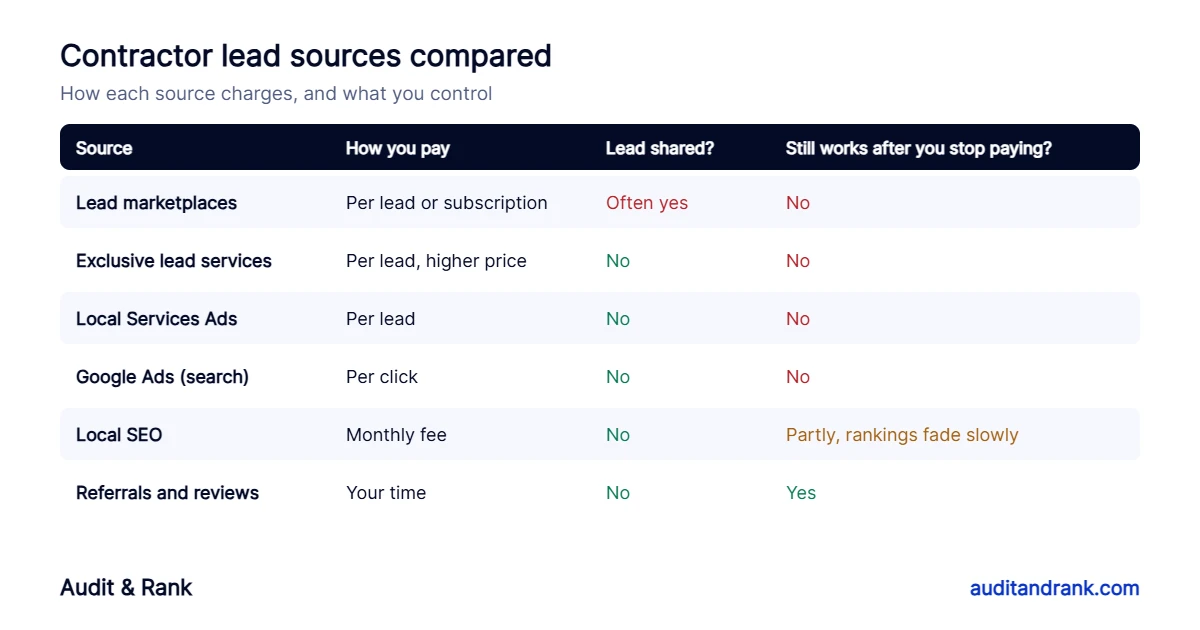
- Lead marketplaces such as Angi, HomeAdvisor and Thumbtack match homeowners with pros. Depending on the platform and plan, the same request can go to several contractors.
- Exclusive lead services sell each lead to one contractor only, usually at a higher price per lead.
- Local Services Ads appear at the top of Google with a Google Screened or Google Guaranteed badge, and you pay per lead.
- Google Ads charge per click on your ad, whether or not the visitor calls.
- Local SEO earns your place in the map pack and organic results through your profile, website and reviews.
- Referrals and repeat customers cost time and good work, and usually close best.
Shared leads vs exclusive leads: what is the difference?
Short answer: a shared lead can be sent to several contractors at once; an exclusive lead goes only to you.
With shared leads, the homeowner may get calls from three or four companies within minutes. The contractor who replies first and sounds most trustworthy usually wins, and the others paid for a lead that went nowhere. Exclusive leads cost more each, but you are not in a race. That is why many contractors find that exclusive sources give a lower cost per booked job, even when the cost per lead is higher. In lead generation for contractors, the price of a lead matters far less than the price of a job.
Are lead sites like Angi and HomeAdvisor worth it?
Short answer: they can help when you need work quickly, but they work best as a top-up, not as your main source.
Lead marketplaces bring volume fast and handle the advertising for you, which makes them a quick option for lead generation for contractors who are short on work. The trade-offs are that you do not own the customer relationship, lead quality varies, and you have to respond very quickly to win shared leads. If you use them, track every lead in a simple sheet: date, source, cost, whether you reached the customer, and whether it became a job. After a month or two you will know your real cost per booked job.
How do Local Services Ads work for contractors?
Short answer: you pay for leads that come through your ad, not for clicks, and the ad shows Google’s badge at the top of the results.
To appear, your business goes through Google’s screening for your trade. Your ranking inside Local Services Ads depends on factors such as your reviews, how quickly you respond and your budget. You can dispute leads that are clearly not valid. They are a strong lead generation for contractors option for urgent trades like plumbing, HVAC and electrical work, but the cost per lead rises in competitive cities and the calls stop when the budget runs out.
How does local SEO compare on cost per lead?
Short answer: local SEO costs a monthly fee instead of a fee per lead, so the cost of each call usually falls as your rankings grow.
Local SEO is the best long-term lead generation for contractors strategy, but it is slower to start. It means optimizing your Google Business Profile, building a page for each main job on your website, collecting reviews and fixing your directory listings. Once you rank in the map pack for your main jobs, the calls keep coming without a fee for each one, and rankings fade slowly rather than stopping overnight. Read our complete guide to local SEO for home service businesses for the full process.
Which lead generation for contractors source is right for my business?
Short answer: it depends on how fast you need work and how much you can invest in building your own lead flow.
- Need jobs this month: Local Services Ads or a small Google Ads budget, plus fast follow-up on every lead.
- New business with no reviews: lead marketplaces can help you get first jobs and reviews, while you set up your Google Business Profile.
- Established business that wants to stop paying per lead: invest in local SEO and reviews, and reduce paid sources as calls grow.
- High-value jobs such as roofing and remodeling: focus on exclusive sources and strong project pages with real photos.
How do I turn more leads into booked jobs?
Short answer: reply fast, follow up, and make it easy to say yes. Most lost jobs are lost after the lead arrives, so even the best lead generation for contractors fails without a good follow-up process.
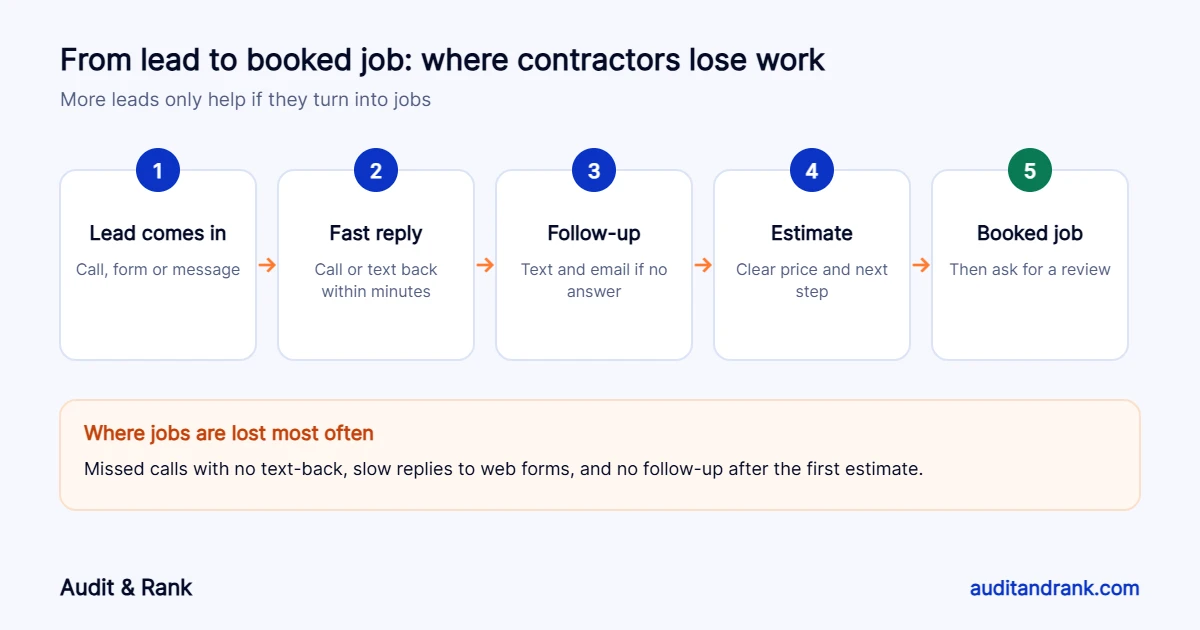
- Answer calls, or send an automatic text-back when you miss one while on a job.
- Reply to web forms within minutes during working hours.
- Follow up by text and email if the customer does not answer the first time.
- Send a clear estimate with a simple next step.
- After the job, ask for a Google review. It helps you win the next lead.
How do I track cost per booked job?
Short answer: divide what you spent on a source by the number of jobs it produced, not by the number of leads.
Tracking your lead generation for contractors results is simple. Use a different tracking number or form for each source, or ask every new customer how they found you. Review the numbers monthly. A source with cheap leads but few jobs often costs more than one with expensive leads that close well.
Want lead generation for contractors that brings calls only to you? Our home services SEO and Google Business Profile optimization services start with a free check of your profile and website.
Frequently asked questions
What is the best lead generation for contractors?
There is no single best source. Exclusive sources such as local SEO, your Google Business Profile, Local Services Ads and referrals usually turn into jobs more often than shared leads, because you are not competing with other contractors for the same customer.
Are shared contractor leads worth it?
They can fill a slow week, but the same lead is often sent to several contractors, so you need to respond very fast and expect a lower close rate. Track cost per booked job, not cost per lead.
What are exclusive home improvement leads?
Leads that are sent only to you. They usually cost more per lead than shared leads, but they tend to close more often because the customer is not comparing several contractors who all called at once.
How do contractors get leads without paying per lead?
Build your Google Business Profile, a page for each main job on your website, reviews from every happy customer and referrals. These take longer to build but do not charge you for every lead.
How long does local SEO take to bring contractor leads?
Profile and website fixes can help within weeks. Steady growth in calls usually takes three to six months, depending on your trade, area and competition.